Ohio Cities Aren’t Waiting on Washington to Fix Housing
July 23, 2026
From zoning reform to infrastructure investment, Ohio cities are tackling the biggest obstacles to new housing as a rare piece of federal housing legislation becomes law without the president’s signature.
Housing has become one of the defining challenges of our time, and mayors are on the front lines of responding to it. In May, U.S. housing starts fell to an annual rate of 1.17 million, the lowest level since the pandemic disrupted construction six years ago, and an 8.5 percent decline from May 2025, according to the U.S. Census Bureau. Even as states and local governments work to address persistent housing shortages, rising construction costs and infrastructure constraints continue to slow the production of new homes.
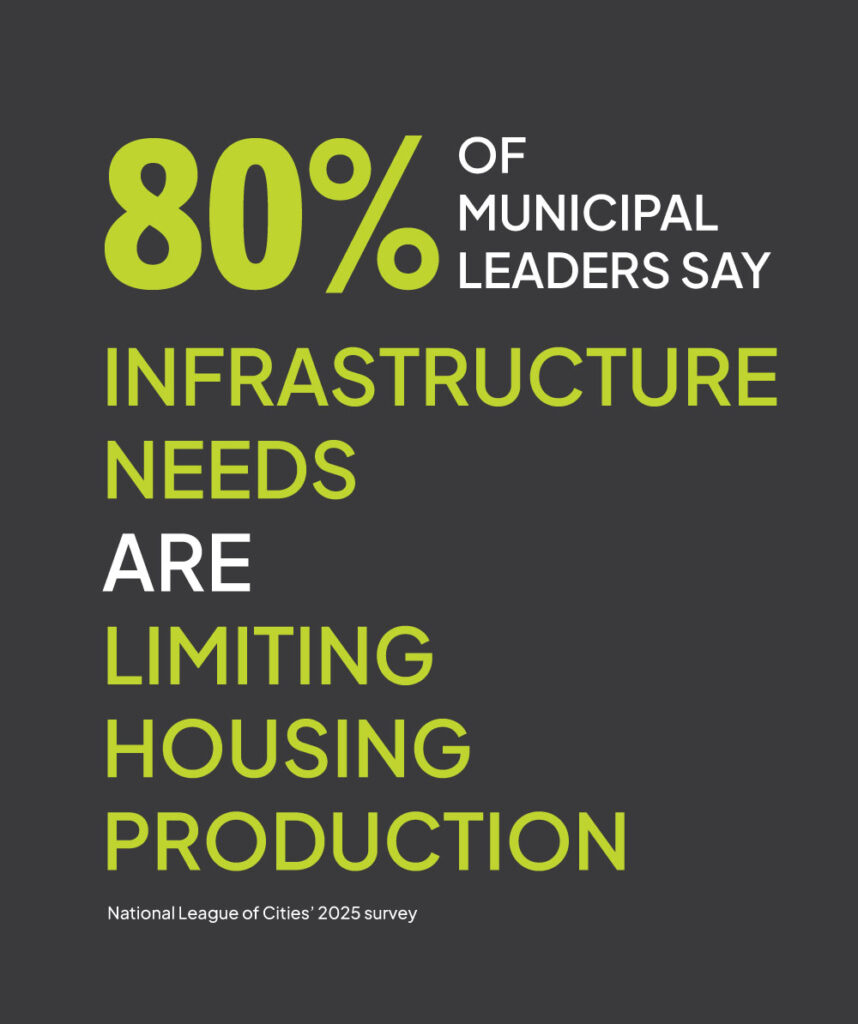
Local leaders increasingly point to infrastructure as one of the biggest barriers to new housing. Even when land is available and zoning allows development, projects can stall because the water, sewer, roads, or utility capacity needed to support growth is not in place. A National League of Cities’ 2025 survey found that 80 percent of municipal leaders say infrastructure needs are limiting housing production, while 51 percent identified infrastructure costs as their single greatest obstacle. Among local governments struggling with water and sewer capacity, 86 percent said cost was the primary challenge.
The consequences are increasingly visible. Nationally, a record 25.2 million adults under age 35—nearly one in three—lived with their parents last year, according to Realtor.com. That trend is driven more by affordability than unemployment, as nearly 70 percent of adults ages 25 to 34 who still live at home are employed. Meanwhile, national home prices have risen more than 34 percent since 2019. While Ohio remains more affordable than many parts of the country, housing costs continue to climb here as well, with the state’s median home price reaching approximately $274,000 in May, up 5.4 percent from the previous year.
A Rare Moment in Washington
Against that backdrop, Congress accomplished something it had not done in a generation by passing comprehensive federal housing legislation with overwhelming bipartisan support. The 21st Century ROAD to Housing Act passed the Senate by an 85-5 vote and the House by a 358-32 vote. Although President Trump neither signed nor vetoed the legislation, it became law on July 11 after the constitutional review period expired.
The legislation expands and modernizes two of the federal government’s primary community development programs, the HOME Investment Partnerships Program and the Community Development Block Grant (CDBG) program, while giving communities greater flexibility to use both for housing-related infrastructure, including water and sewer lines, roads, sidewalks, and utility connections. It also streamlines environmental review for smaller housing developments and limits large institutional investors from purchasing single-family homes.
Importantly, the National League of Cities notes that the legislation preserves local zoning and land-use authority while avoiding new unfunded mandates. Rather than prescribing a one-size-fits-all approach, the legislation gives local leaders additional tools to support the housing strategies already underway in their communities.
Cities Leading the Way
While Washington debated policy, Ohio’s municipalities were busy advancing local solutions. Below is just a small sample of the innovative and impactful work Ohio cities are doing to address the housing needs of their residents.
Akron
Akron Mayor Shammas Malik announced a series of housing initiatives, including a new down payment assistance program offering up to $7,500 for income-qualified homebuyers, stronger mold enforcement and rental registry requirements, and an “Easing Barriers to New Housing” proposal. The proposal would expand opportunities for missing-middle housing, including duplexes and accessory dwelling units, reduce regulatory hurdles for existing properties, and eliminate minimum lot-size requirements. City officials estimate these changes could make nearly 2,000 city-owned vacant lots available for future housing.
Cleveland
Cleveland City Council approved Mayor Justin Bibb’s Housing Innovation District, combining zoning reform, tax incentives, and infrastructure investment to encourage new development in East Side neighborhoods. The initiative waives permit fees for new single-family homes, introduces form-based zoning to promote walkable neighborhoods, and establishes a tax increment financing district to support future infrastructure improvements. Cleveland is also investing $750,000 to build 20 new homes on city-owned vacant lots while supporting nearby home repairs and commercial improvements.
Cleveland Heights
Nearby, Cleveland Heights is also using vacant land to expand housing opportunities. The city’s Architectural Board of Review recently approved two new home designs for an infill housing initiative led by Rebuild Cleveland and FutureHeights, with additional designs planned to bring more housing options to the community.
Youngstown
In Youngstown, a $2.5 million grant from the state’s new Residential Economic Development District (REDD) program is supporting an infill housing initiative expected to produce up to 220 workforce housing units. The funding will improve roads, sidewalks, and lighting while connecting new homes to existing water and sewer systems. Homebuyers will also receive a 15-year, 100 percent property tax abatement and down payment assistance through the city’s At Home program, a partnership with the Youngstown Neighborhood Development Corporation and Mercy Health Youngstown.
Warren
Just down the road in Warren, an $851,000 REDD grant is supporting the Peninsula Project, which will modernize aging water and sewer infrastructure to make way for roughly 306 new apartments and townhomes, including units reserved for essential workers earning at or below 80 percent of area median income.
Lancaster
In Lancaster, local officials secured a $1 million REDD grant to extend water and sewer service, construct roads, and build sidewalks for a mixed-income housing development that complements roughly $70 million in private investment. The city has also modernized its zoning code and reduced development fees to encourage new construction. Those efforts recently helped bring the Reserve at Hunter Trace to completion, a $27 million affordable senior housing development providing 95 homes for residents earning up to 60 percent of area median income.
Euclid
Euclid City Council unanimously adopted zoning code updates to remove common barriers to infill housing. The reforms expand the types of homes permitted in residential districts, right-size lot and setback requirements, and streamline approvals for smaller-scale projects, making it easier to build new homes on vacant lots that previously faced zoning obstacles.
Toledo
In the northwest corner of the state, Toledo adopted Forward Toledo, its first comprehensive land-use plan in more than two decades. Developed through an extensive public engagement process that included 39 community events and more than 3,000 survey responses, the plan is organized around five themes—Build, Move, Place, Play, and Sustain—and makes housing diversity and affordability a central priority. The city is now rewriting its zoning code to align with those goals, expanding housing options and removing barriers to infill development citywide.
Lima
Meanwhile, in Lima, the Build-Ready program allows residents to access free pre-approved home plans, property tax abatements of up to 100 percent for 15 years, and waived utility tap fees. The city has paired those incentives with neighborhood revitalization efforts, including a voluntary demolition program that has removed 161 blighted structures since 2022, a land bank with more than 150 available properties, home repair assistance programs, and down payment assistance of up to $9,999 for first-time homebuyers.
Columbus
In central Ohio, Columbus is undertaking the largest overhaul of its zoning code in the city’s history. Mayor Andrew Ginther’s Zone In initiative is modernizing development regulations to support more housing, economic opportunity, and walkable neighborhoods. Complementing these regulatory reforms, the city has also leveraged more than $750 million to build and preserve affordable housing.
Cincinnati
Further south in Cincinnati, Mayor Aftab Pureval’s administration established the city’s first dedicated revenue source for its $100 million Affordable Housing Trust Fund, helping triple affordable housing production in just two years. The city also implemented a comprehensive zoning overhaul that opens transit corridors to missing-middle housing while directing repair investments to historically overlooked neighborhoods.
See Mayor Pureval talk about Cincinnati’s progress on housing in his recent appearance the Daily Show:
From Youngstown to Cincinnati, one thing is clear:
Ohio cities aren’t waiting on Washington to tackle the housing challenge.
Mayors are already implementing innovative local solutions that reflect the needs of their residents. When state and federal policymakers provide flexible funding and infrastructure support while preserving local decision-making authority, cities have the tools they need to expand housing opportunities and ensure more Ohioans have access to safe, affordable places to call home.